


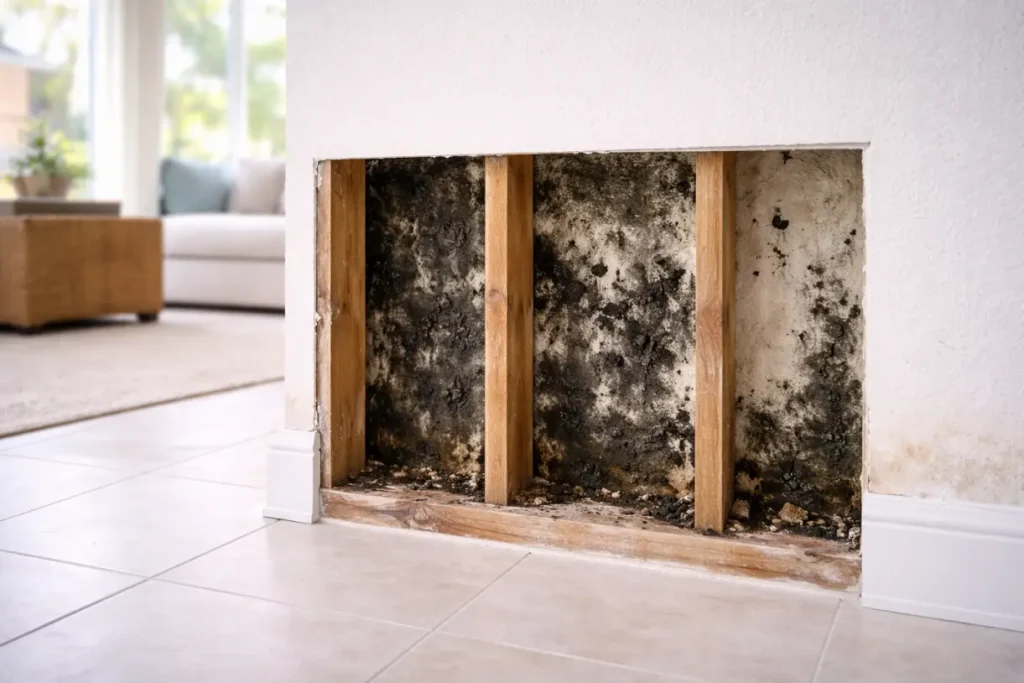
If you own a home in Miami-Dade, Broward, or Palm Beach County, mold is not a possibility. It is a probability.
South Florida’s subtropical climate delivers average humidity levels above 70% for most of the year, annual rainfall approaching 60 inches, and a hurricane season that runs six months from June through November. Every one of those conditions feeds mold growth. Combined, they make the tri-county region one of the highest-risk areas in the country for indoor mold contamination.
A 2026 study ranked Florida second only to Louisiana as the state where homes are most likely to have or develop mold problems. That finding surprised nobody who lives here. What does surprise homeowners is how fast mold establishes itself after water intrusion, how narrowly Florida insurance policies cover mold damage, and how much the law actually requires when it comes to professional mold assessment.
This guide covers the regulatory framework, health risks, insurance realities, and inspection requirements that South Florida homeowners need to understand, whether you are preparing for hurricane season, recovering from a flood, buying or selling a home, or simply noticing a musty smell that was not there last month.
Key Takeaways
- ● The 48-Hour Rule: Mold begins colonizing wet surfaces within 24 to 48 hours of water exposure. In South Florida’s humidity, that timeline accelerates.
- ● Hidden Hazards: The most damaging mold in South Florida occurs in concealed locations — wall cavities, HVAC systems, under flooring — invisible without professional testing.
- ● Statutory Separation: Florida law (Chapter 468) prohibits the same company from performing both mold assessment and remediation on the same property within 12 months.
- ● Insurance Limitations: Standard policies often cap mold coverage. Independent documentation is required to link mold to a “covered peril” and support your claim.
Why South Florida Is a Mold Environment
Mold needs three things to colonize building materials: moisture, an organic food source, and time. South Florida provides the first two in abundance. The third is measured in hours, not weeks.
According to the EPA, mold can begin growing on wet surfaces within 24 to 48 hours of water exposure. In a climate where indoor humidity routinely exceeds 60% without mechanical intervention, that timeline accelerates. Homes throughout Miami, Fort Lauderdale, Boca Raton, West Palm Beach, Delray Beach, Boynton Beach, and Parkland face the same environmental equation: warm air holds more water vapor, and South Florida’s air rarely cools enough to stop holding it.
The building materials in most South Florida homes, including drywall, wood framing, carpet, ceiling tiles, and wallpaper, provide the organic food source mold requires. Even settled dust on hard surfaces contains enough organic matter to sustain mold colonies once moisture is present.
The critical variable is always water. In South Florida, water intrusion comes from multiple directions simultaneously: roof leaks during storms, plumbing failures behind walls, HVAC condensation from systems running year-round, flooding from storm surge and heavy rainfall, and the persistent ambient humidity that saturates building materials even without a specific water event.
Mold Growth Timeline: From water intrusion to visible contamination.
The Hurricane and Flood Factor
Hurricane season transforms mold risk from chronic to acute. When a storm compromises a roof, breaks a window seal, or floods a ground-level living space, the 24-to-48-hour clock starts immediately. The problem is that post-storm conditions, including power outages that disable air conditioning, standing water that cannot drain, and overwhelmed contractor availability, make it nearly impossible to dry affected areas within that window.
Key finding from University of Miami research: Anywhere water touches drywall, that drywall must be removed at least two feet above the waterline. Without removal, moisture trapped inside wall cavities begins producing visible mold spores within three to seven days.
The 2-Foot Cut Rule: Why drywall must be removed well above the visible waterline.
South Florida’s flat terrain and dense canal systems compound the problem. Stormwater drainage is slow, standing water accumulates around foundations, and post-hurricane flooding can saturate walls, flooring, and insulation before homeowners even assess the extent of the damage.
Floodwater carries additional contamination. Storm surge and flooding often introduce sewage, chemicals, and concentrated mold spores from outdoor sources directly into the home. Even after visible water recedes, the materials it contacted may harbor biological hazards that are invisible without professional assessment.
The Florida Department of Health advises homeowners to keep indoor humidity below 60%, with below 50% considered ideal for preventing both mold growth and dust mite proliferation. After a flood or significant water event, achieving those levels without professional drying equipment and assessment is unlikely.
Where Mold Hides in South Florida Homes
Visible mold, the dark patches on a bathroom ceiling or the discoloration behind a kitchen sink, represents only what has already become obvious. In South Florida homes, the most damaging mold growth typically occurs in concealed locations where moisture accumulates undetected.
South Florida Home Mold Hot Zones: Where hidden contamination develops.
Common concealed mold locations in South Florida homes include:
- Inside wall cavities behind drywall, particularly around plumbing penetrations
- Behind baseboards and under flooring in areas with previous water exposure
- Inside HVAC ductwork, on evaporator coils, in drain pans, and on liner surfaces
- Above ceiling tiles and inside attic spaces where roof leaks have occurred
- Under carpet padding that absorbed moisture from flooding or slab leaks
- Behind cabinetry in kitchens and bathrooms where slow plumbing leaks persist
- Inside closets on exterior walls where condensation forms due to temperature differentials
- Around window frames and door seals compromised by storm damage or age
Air conditioning systems deserve particular attention in South Florida. HVAC units run nearly year-round in the tri-county area. When not properly maintained, drain pans overflow, condensate lines clog, and moisture accumulates on evaporator coils. Mold colonies established inside the air handling system distribute spores throughout every room the system serves. A single contaminated HVAC system can affect an entire home’s indoor air quality without producing any visible mold on walls or ceilings.
Health Effects of Indoor Mold Exposure
The health consequences of indoor mold exposure are well documented by federal health agencies, even though no federal standards currently exist for acceptable indoor mold levels.
Institute of Medicine (2004): Found sufficient evidence linking indoor mold exposure to upper respiratory tract symptoms, coughing, and wheezing in otherwise healthy individuals, and to worsened asthma symptoms in people with asthma.
World Health Organization (2009): Issued additional guidance reinforcing the connection between indoor dampness, mold, and respiratory health effects.
EPA: Mold produces allergens, irritants, and in some cases potentially toxic substances called mycotoxins. Exposure can cause allergic reactions including sneezing, runny nose, red eyes, and skin rash. These reactions can be immediate or delayed, making it difficult for occupants to connect symptoms to their indoor environment without professional testing.
CDC: Mold exposure can irritate the eyes, skin, nose, throat, and lungs of both mold-allergic and non-allergic people. Children, elderly individuals, people with respiratory conditions, and those with weakened immune systems face elevated risk. Research has also suggested a potential link between early mold exposure and asthma development in genetically susceptible children.
The absence of federal exposure standards is itself significant. Because no regulatory threshold defines “safe” versus “unsafe” mold levels, the only defensible approach is professional assessment that identifies what species are present, at what concentrations, and whether those concentrations differ meaningfully from outdoor baseline conditions. This is precisely what professional mold testing provides, and precisely what DIY test kits cannot deliver reliably.
What Florida Law Requires for Mold Assessment
Florida regulates mold-related services more rigorously than many homeowners realize. Chapter 468, Part XVI of the Florida Statutes establishes licensing requirements, scope of practice, and penalties for unlicensed activity in mold assessment and remediation.
Under this statute, a “mold assessment” is defined as a process that includes physical sampling and detailed evaluation of data obtained from a building history and inspection to formulate a hypothesis about the origin, identity, location, and extent of mold growth greater than 10 square feet. Only licensed mold assessors may perform this work.
The licensing requirements are substantial. Applicants must pass a state-approved examination, demonstrate education in a relevant scientific field, complete documented field experience, undergo a criminal background check, and maintain continuing education credits throughout their licensure period. Florida licenses individual assessors, not businesses.
Florida law mandates separation between mold assessment and mold remediation. Under Section 468.8419, a mold assessor may not perform or offer remediation to a structure on which the assessor or the assessor’s company provided an assessment within the previous 12 months. The same restriction applies in reverse: a remediator may not assess a structure where they performed remediation within the past 12 months.
This statutory separation exists because Florida lawmakers recognized the inherent conflict of interest when the same company both diagnoses the problem and sells the solution. A company that profits from remediation has a financial incentive to identify problems requiring expensive removal. An independent assessor has no such incentive.
Licensed mold assessors must also carry a minimum $1,000,000 insurance policy covering both preliminary and post-remediation assessment work. Unlicensed mold assessment activity constitutes a criminal offense under the statute, escalating from a second-degree misdemeanor for a first violation to a third-degree felony for a third or subsequent violation.
The Insurance Problem Most Homeowners Discover Too Late
Mold coverage under Florida homeowners insurance is far more limited than most policyholders assume. Understanding these limitations before a mold event occurs is the difference between manageable costs and devastating out-of-pocket expenses.
Florida law permits insurers to cap mold remediation coverage. Most standard policies set sublimits that are often far below actual remediation costs. Many homeowners discover these sublimits only after filing a claim. Professional mold remediation in South Florida can range from several thousand dollars for minor contamination to well over $100,000 for severe cases involving structural damage and whole-home treatment.
Standard Florida homeowners policies generally cover mold damage only when it results directly from a covered peril, such as a burst pipe or wind-driven rain from a hurricane. Mold that develops from gradual moisture, poor ventilation, chronic humidity, or maintenance neglect is almost universally excluded.
How Insurers Deny or Minimize Mold Claims
- Attribution disputes: The insurer argues mold resulted from ambient humidity or homeowner neglect rather than a covered event. This is particularly effective in South Florida, where the climate itself creates moisture conditions insurers can blame.
- Delayed reporting: If the homeowner did not report water damage or mold promptly, the insurer argues the delay allowed the problem to worsen beyond what the original event caused.
- Pre-existing condition claims: Adjusters assert mold was present before the insured event, particularly when growth is extensive at the time of the claim.
- Scope disputes: Even when the insurer acknowledges some coverage, adjusters may underestimate contamination extent, exclude affected areas, or offer amounts below what licensed remediators actually charge.
Independent mold testing creates the documentation that counters these denial tactics. A licensed mold assessor’s report establishes what species are present, where contamination exists, how extensive it is, and what conditions caused it. This documentation links mold growth directly to a specific water event, provides scientific data on contamination scope, and creates a defensible record that an insurance adjuster cannot dismiss as subjective.
AirMD’s mold testing and inspection services provide exactly this documentation. Because AirMD does not perform remediation, our assessment reports carry the credibility of independence, documenting conditions without financial incentive to over-scope the problem or recommend unnecessary removal.
Don’t Wait Until Mold Becomes an Insurance Dispute
Whether you are responding to water damage, preparing for hurricane season, or buying a home in South Florida, independent mold testing provides the scientific documentation that protects your health, your property, and your insurance claim. AirMD does not perform remediation, ensuring every assessment serves your interests, not a remediation sales pipeline.
Schedule Your Mold Inspection → | Call 888-462-4763
Mold and Real Estate Transactions in South Florida
Florida’s real estate disclosure framework creates specific obligations and risks around mold that affect both buyers and sellers.
Florida law requires residential property sellers to disclose any known facts that materially affect the property’s value and are not readily observable to the buyer. This obligation originates from the Florida Supreme Court’s 1985 ruling in Johnson v. Davis, which established that intentional concealment or misrepresentation of material defects creates legal liability for the seller.
Mold qualifies as a material defect. If a seller knows about recurring mold problems, past remediation, or hidden water damage contributing to mold growth, Florida law requires disclosure. The standard Florida Realtors’ Seller’s Property Disclosure Form includes specific references to mold and water intrusion. Real estate agents who are aware of mold issues cannot legally withhold that information, even if the seller prefers silence.
Selling a home “as-is” does not eliminate these disclosure obligations. The seller is still legally required to disclose known hidden defects. Failure to disclose can result in lawsuits for fraud or misrepresentation, court-ordered payment for repairs, or cancellation of the sale.
For buyers, professional mold testing before closing is a protective investment. A standard home inspection may note visible mold or moisture staining, but it does not include laboratory analysis identifying specific mold species and concentrations. Professional mold testing provides the scientific data needed to make informed purchase decisions, negotiate repair concessions, or walk away from a property with hidden contamination.
For sellers, proactive testing before listing prevents deal disruption. Addressing mold issues before a buyer’s inspection discovers them avoids last-minute price negotiations, extended closing timelines, and the risk of a collapsed transaction. Independent testing documentation from a company that does not perform remediation demonstrates good faith and provides a credible record for the disclosure process.
DIY Mold Test Kits vs. Professional Mold Testing
Homeowners often consider DIY mold test kits as a first step. Understanding what each approach actually delivers helps determine when a kit is sufficient and when it is not.
| DIY Mold Test Kits | Professional Mold Testing (AirMD) | |
|---|---|---|
| What is tested | Surface samples only | Air samples, surface samples, and moisture sources |
| Airborne spore detection | No | Yes, calibrated air sampling equipment |
| Moisture source identification | No | Yes, advanced detection of liquid water and water vapor |
| Species identification | Limited or unreliable | Accredited laboratory analysis with full species report |
| Concealed mold detection | No, surface access only | Yes, targets wall cavities, HVAC systems, under flooring |
| Insurance claim documentation | Not accepted | Meets documentation standards for claims and legal proceedings |
| Real estate transaction use | Not accepted | Provides defensible documentation for buyers and sellers |
| Remediation plan included | No | Yes, detailed scope of work for contractor bidding |
| Conflict of interest | N/A | None. AirMD does not perform remediation. |
The CDC does not recommend mold sampling as a general practice. However, when testing is necessary, particularly for insurance claims, real estate transactions, health investigations, or post-storm assessments, professional testing from a licensed, independent assessor is the only approach that produces actionable, defensible results.
Why Independent Testing Changes the Outcome
The separation between assessment and remediation that Florida law requires exists for a reason. But meeting the legal minimum is different from maximizing the protection that independent testing provides.
Companies that both test and remediate mold face a structural conflict even if they comply with the 12-month restriction. The business model depends on finding problems that generate remediation revenue. An independent testing company that performs no remediation has no financial interest in the outcome of the assessment. The report reflects what the laboratory analysis shows, nothing more.
Why independence matters: The conflict model vs. AirMD’s independent assessment approach.
AirMD’s mold testing protocol combines multiple scientific approaches:
- Visual inspection: Systematic examination for visible growth, moisture intrusion, and conditions supporting mold development.
- Air sampling: Collection of airborne spore samples for laboratory analysis, identifying species and concentrations that visual inspection cannot detect.
- Moisture and water vapor assessment: Advanced detection equipment reveals liquid water and water vapor intrusion sources, the root cause of every mold problem.
- Independent laboratory analysis: Accredited laboratory identification and quantification of all mold species present, providing scientific data rather than visual guesswork.
The resulting report serves multiple purposes. For minor, localized issues, it provides straightforward steps the homeowner can handle independently. For larger or more complex problems, it delivers a detailed remediation plan that can be given directly to restoration contractors, ensuring the work is appropriate and not unnecessarily expanded beyond what the conditions actually require.
This remediation plan is the homeowner’s protection against over-scoping. When a remediation contractor provides both the diagnosis and the treatment, the homeowner has no independent benchmark for what the work should actually include. AirMD’s assessment report defines the scope based on laboratory data. The homeowner can then solicit competitive bids from remediation contractors against a defined scope of work, rather than accepting a single company’s assessment of what they believe needs to be done.
South Florida Hurricane Mold Prevention Cheat Sheet
Save or print this checklist. Every step reduces your mold risk and strengthens your insurance position.
Phase 1: Before Hurricane Season (June 1 Deadline)
- Inspect roof, plumbing, and window seals for existing vulnerabilities.
- Clean HVAC drain pans and verify condensate lines are clear and flowing.
- Test your dehumidifier. Confirm it maintains indoor humidity below 50%.
- Photograph your home’s current condition with dated images, including behind furniture, inside closets, and around plumbing fixtures.
- Review your insurance policy. Check mold coverage sublimits and consider purchasing additional mold coverage if your current limit is inadequate.
- Identify a licensed, independent mold assessor before you need one. Post-storm demand overwhelms availability.
Phase 2: Immediately After a Water Event (0–24 Hours)
- Remove standing water as quickly as possible.
- Cut out flood-contacted drywall at least two feet above the visible waterline.
- Run floor fans and open windows to create airflow. Do not rely solely on AC for drying.
- Document all damage with photographs and video before beginning cleanup.
- Contact your insurance company immediately to report the water event. Delayed reporting weakens your claim.
Phase 3: Within 48 Hours
- If affected areas are not completely dry, schedule professional mold testing. This establishes a baseline before visible mold growth and links any contamination directly to the water event.
- Do not wait for visible mold to appear. By the time mold is visible, contamination may already be extensive behind walls, under flooring, and inside HVAC systems.
- Preserve all documentation. Photos, insurance correspondence, contractor receipts, and mold assessment reports create the evidence chain that supports your claim.
Real Questions South Florida Homeowners Ask About Mold Testing
My home smells musty but I cannot see any mold. Is testing necessary?
A musty odor without visible mold is one of the strongest indicators of hidden mold growth in concealed areas. Mold commonly develops inside wall cavities, behind cabinetry, within HVAC ductwork, and under flooring where it cannot be seen. Professional mold testing uses air sampling and moisture detection equipment to identify contamination that visual inspection alone cannot reveal. AirMD’s assessment protocol specifically targets these concealed locations to determine whether the odor reflects active mold growth requiring remediation or a moisture condition that can be corrected before mold establishes itself.
How soon after a hurricane or flood should I get mold testing done?
Mold testing should be scheduled within the first week after any water intrusion event where affected areas could not be fully dried within 48 hours. The EPA’s guidance establishes that mold can begin growing within 24 to 48 hours of water exposure. Early testing creates baseline documentation before mold becomes visible, directly linking any contamination to the specific water event. This timeline documentation is critical for insurance claims, as insurers routinely argue that delayed action by the homeowner allowed mold to develop or worsen beyond what the covered event caused.
Does my Florida homeowners insurance actually cover mold damage?
Florida homeowners insurance typically covers mold only when it results directly from a covered peril, and coverage is almost always subject to sublimits. Standard policies cover mold caused by events like burst pipes or hurricane damage but exclude mold from gradual moisture, poor ventilation, or maintenance issues. Florida law permits insurers to cap mold coverage, and many policies set limits that homeowners discover only after filing a claim. Independent mold testing from AirMD creates the documentation that connects mold growth to a specific covered event, providing the scientific evidence needed to support your claim when the insurer disputes causation.
Why does it matter whether my mold testing company also does remediation?
Florida law prohibits the same company from performing both mold assessment and mold remediation on the same property within 12 months. Section 468.8419 of the Florida Statutes establishes this separation because of the inherent conflict of interest when the company diagnosing the problem also profits from selling the solution. Beyond legal compliance, independence determines whose interests the assessment serves. AirMD does not perform remediation. Our assessment reports reflect laboratory data, not business development. This independence means the remediation plan in your report defines the actual scope of work required, giving you a defensible benchmark when soliciting competitive bids from remediation contractors.
I am buying a home in South Florida. Should I get mold testing beyond the standard home inspection?
Professional mold testing goes significantly beyond what a standard home inspection covers. A standard inspection may identify visible mold or moisture staining but does not include laboratory analysis of mold species and concentrations, air sampling for airborne spores, or advanced moisture detection behind walls and under flooring. In South Florida’s climate, where mold can thrive in concealed locations year-round, a standard inspection leaves significant gaps. Professional testing before closing provides scientific documentation of the home’s actual condition and creates leverage for price negotiations or repair concessions if problems are identified. Under Florida’s disclosure law, sellers must reveal known mold issues, but they are not required to conduct mold inspections proactively. The buyer’s own testing fills that gap.
Frequently Asked Questions
How long does it take to get mold testing results?
Professional mold testing results are typically available within 48 to 72 hours of sample collection. Emergency testing is available for urgent situations, including post-storm assessments. Results include scientific identification of mold species, concentration levels, and tailored remediation recommendations when problems are identified.
Can I test for mold myself with a DIY kit?
DIY mold test kits test only surface samples, cannot detect airborne spores, provide no moisture source identification, and lack calibrated instrumentation. DIY results do not meet the documentation standards required for insurance claims, legal proceedings, or real estate transactions. When professional testing is warranted, it should be performed by a licensed mold assessor using accredited laboratory analysis.
Is mold testing required before selling a home in Florida?
No, Florida does not require sellers to conduct mold testing before listing a property. However, sellers must disclose any known material defects, including mold and water intrusion history. Proactive testing before listing identifies conditions that could otherwise surface during a buyer’s inspection, creating deal complications, price renegotiations, or transaction failures.
What types of mold are common in South Florida homes?
The most common indoor mold species in South Florida are Aspergillus, Cladosporium, Penicillium, and Alternaria. Stachybotrys chartarum, commonly called black mold, can develop in areas with prolonged water damage to wood and drywall. Professional laboratory analysis identifies the specific species present, which informs appropriate remediation methods and health risk assessment.
Does Florida require mold assessors to be licensed?
Yes, Florida requires individual licensure for mold assessors under Chapter 468, Part XVI of the Florida Statutes. Licensed assessors must pass a state-approved examination, demonstrate relevant education and field experience, maintain continuing education credits, and carry minimum $1,000,000 insurance coverage. Performing unlicensed mold assessment is a criminal offense under Florida law.
Protect Your Home and Your Investment
South Florida’s climate does not pause, and neither does mold growth. Whether you are responding to a water event, preparing for hurricane season, navigating a real estate transaction, or investigating unexplained health symptoms, professional mold testing provides the scientific foundation for every decision that follows.
AirMD serves homeowners throughout Miami-Dade, Broward, and Palm Beach counties with conflict-free mold inspection services backed by accredited laboratory analysis. We do not perform remediation, ensuring our assessments protect your interests rather than generating removal work for our company.
Contact AirMD to schedule professional mold testing before the next storm, before the next closing, or before that musty smell becomes a health hazard and an insurance dispute. Call 888-462-4763.